Pointing Pairs and Triples
Used in Classic 9×9 Sudoku, 6×6 Sudoku, Difference Sudoku, Irregular 6×6 Sudoku, Relational 6×6 Sudoku, Odd/Even Sudoku, Windowed Sudoku, Killer Sudoku and Triangle Sudoku.
A box and a row (or a box and a column) overlap in three cells. When a digit's candidates in one of them all fall inside that overlap, the other one loses that digit outside it. It comes in two directions, and both are the same idea.
- Pointing. Inside a box, a digit can only go in cells that share a row. The box's copy of that digit will be in that row, so the rest of the row can't have it. The two or three cells "point" along the row.
- Box-line reduction (also called claiming). Along a row, a digit can only go in cells that sit in one box. The row's copy of that digit will be in that box, so the rest of the box can't have it.
Both are called a pointing pair or pointing triple, depending on whether two or three cells are involved. Everything here works the same with columns in place of rows.
An example: a pair
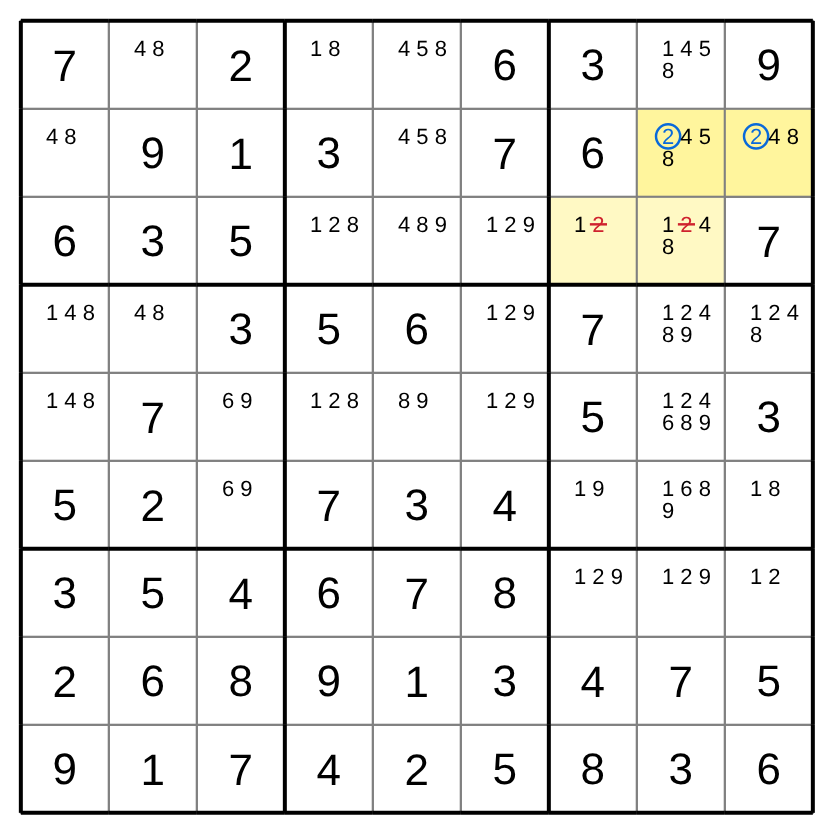
Look at the second row. Where can its 2 go? Of the row's empty cells, only the last two, in the eighth and ninth columns, have 2 as a candidate. Both of those are in the top-right box.
So the row's 2 is in the top-right box, in the second row. That box can only have one 2, so no other cell of the box can be 2. Two cells in the third row lose it:
- the seventh-column cell goes from 1, 2 to just 1, which is now a naked single,
- the eighth-column cell goes from 1, 2, 4, 8 to 1, 4, 8.
An example: a triple
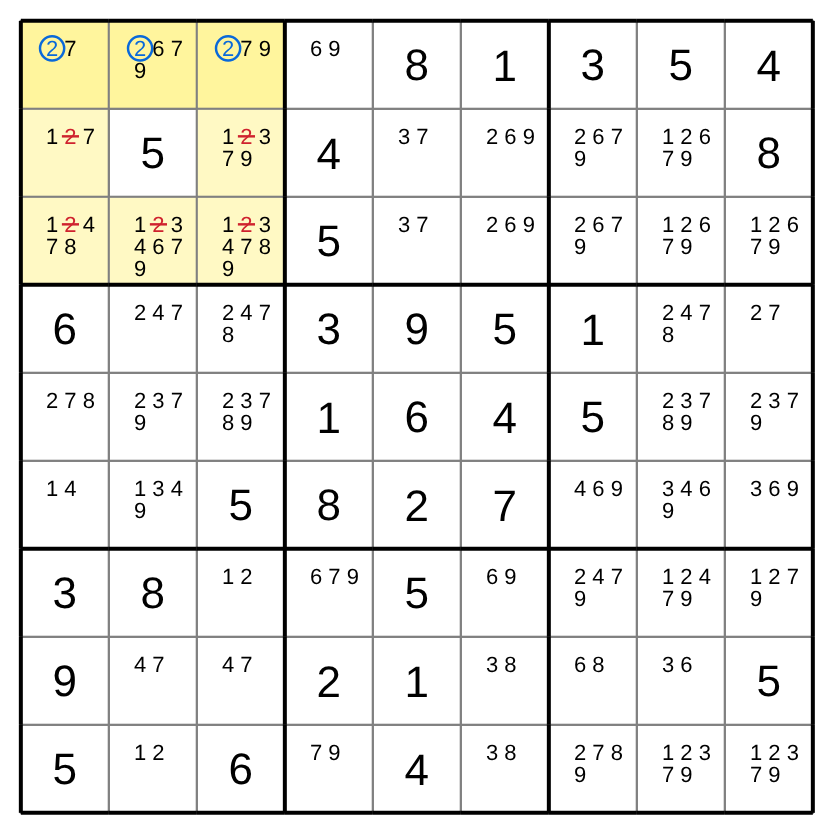
Same idea, three cells. In the top row, the only empty cell outside the top-left box can hold just 6 or 9, so the row's 2 has to be in one of its first three cells. All three are in the top-left box. The box's 2 is therefore in the top row, and every cell of the box in the second and third rows loses its 2: five eliminations from one observation.
How to look for them
- Go box by box, digit by digit. For one digit, look at where it can go inside a box. If all those cells are in one row or one column, follow that line out of the box and strike the digit.
- Then go line by line. For each row and column, check whether a digit's cells all sit inside one box. If so, clear the rest of the box.
- Look where a digit is nearly placed. A digit already on the board six or seven times has few candidates left, and they tend to line up.
Where it fits
Pointing is a Hard technique here, alongside hidden pairs and hidden triples. It works on every variant that has boxes or regions. On the irregular and triangle boards the overlap between a region and a line can be longer than three cells, and the app's hints call that case "Locked candidates"; the reasoning is the same.
More techniques
- Naked Single (Obvious Single): A cell with only one candidate left must hold it. The first thing to look for in any sudoku, and how to spot it quickly.
- Hidden Single: When a digit fits in only one cell of a row, column or box, it goes there, even if that cell has other candidates.
- Naked Pair (Obvious Pair): Two cells in a house with the same two candidates take both digits between them, so the rest of the house can't have either.
- Naked Triple (Obvious Triple): Three cells in a house whose candidates use only three digits take all three, even when no cell shows all of them.
- Hidden Pair: Two digits that fit in only the same two cells of a house claim those cells, so every other candidate there can go.
- Hidden Triple: Three digits confined to the same three cells of a house claim them, clearing out every other candidate in those cells.