Hidden Triple
Used in Classic 9×9 Sudoku, 6×6 Sudoku, Difference Sudoku, Irregular 6×6 Sudoku, Relational 6×6 Sudoku, Odd/Even Sudoku, Windowed Sudoku, Killer Sudoku, Skyscraper Sudoku 5×5 and Triangle Sudoku.
A hidden triple is three digits that, within one row, column or box, can only go in the same three cells. Those cells must hold those three digits, so every other candidate in them can go.
It is a hidden pair one size up, and the mirror image of a naked triple. As with the naked triple, no cell has to show all three digits: what matters is that the three digits appear nowhere else in the house.
An example
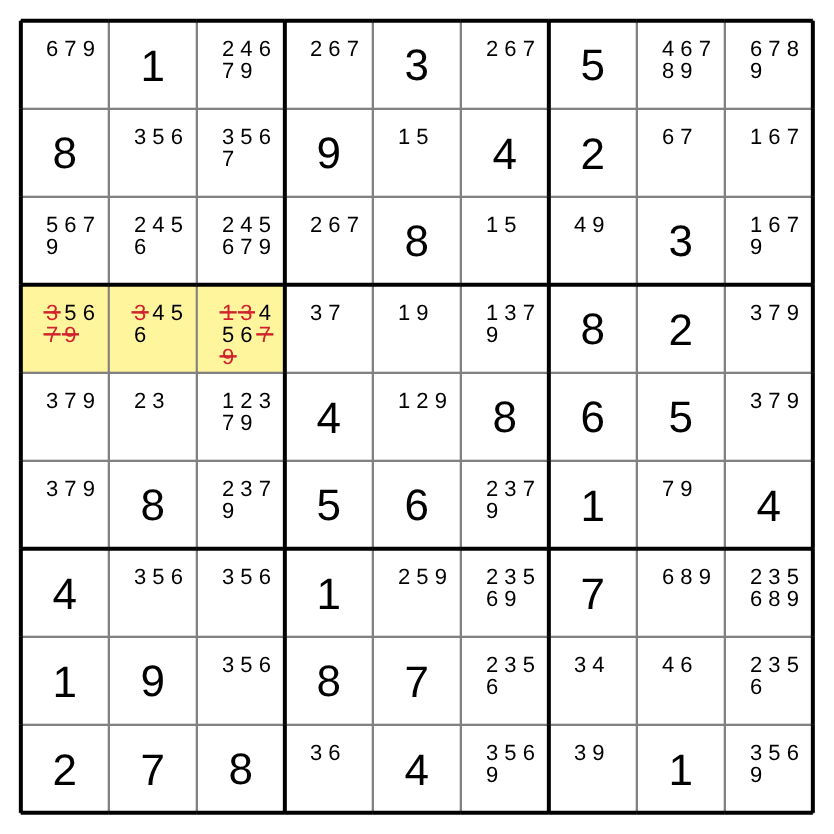
Look at the fourth row. Two of its cells are filled (8 and 2), and seven are empty. The first three cells have plenty of candidates:
- the first: 3, 5, 6, 7, 9
- the second: 3, 4, 5, 6
- the third: 1, 3, 4, 5, 6, 7, 9
Now look at the row's other empty cells: 3 and 7; 1 and 9; 1, 3, 7 and 9; 3, 7 and 9. None of them has a 4, a 5 or a 6. The row needs all three, so they must go in the first three cells.
With three digits for three cells, there's no room for anything else:
- the first cell loses 3, 7 and 9, leaving 5 and 6,
- the second loses 3, leaving 4, 5 and 6,
- the third loses 1, 3, 7 and 9, leaving 4, 5 and 6.
The first cell never had a 4, and that doesn't matter. It only has to be one of the three.
How to look for them
- Count cells per digit. In a house, list for each missing digit the cells it can go in. Three digits whose cells, taken together, are only three cells make a triple.
- Look at the empty cells you're not using. In the example, the quickest way to see it is that the other four cells only use 1, 3, 7 and 9. That is a naked quad, and its leftover digits form the hidden triple. Every hidden set has a naked set beside it in the same house, and sometimes that one is easier to see.
- Write in all the candidates first. Like the hidden pair, this is close to impossible to find by eye.
Where it fits
The hidden triple is a Hard technique here. It is less common than the hidden pair, and when a puzzle needs one it is often the step that the whole solve turns on. If you can't find a triple, look for pointing pairs next.
More techniques
- Naked Single (Obvious Single): A cell with only one candidate left must hold it. The first thing to look for in any sudoku, and how to spot it quickly.
- Hidden Single: When a digit fits in only one cell of a row, column or box, it goes there, even if that cell has other candidates.
- Naked Pair (Obvious Pair): Two cells in a house with the same two candidates take both digits between them, so the rest of the house can't have either.
- Naked Triple (Obvious Triple): Three cells in a house whose candidates use only three digits take all three, even when no cell shows all of them.
- Hidden Pair: Two digits that fit in only the same two cells of a house claim those cells, so every other candidate there can go.
- Pointing Pairs and Triples: A digit confined to one line inside a box (or to one box along a line) can be removed from the rest of that line or box.