Hidden Pair
Used in Classic 9×9 Sudoku, 6×6 Sudoku, Difference Sudoku, Irregular 6×6 Sudoku, Relational 6×6 Sudoku, Odd/Even Sudoku, Windowed Sudoku, Killer Sudoku, Skyscraper Sudoku 5×5 and Triangle Sudoku.
A hidden pair is two digits that, within one row, column or box, can only go in the same two cells. Those two cells must hold those two digits, so any other candidate in them can be removed.
It is the mirror image of a naked pair. A naked pair is two cells with only two digits; a hidden pair is two digits with only two cells. The cells in a hidden pair usually show several other candidates, which is what hides it.
An example
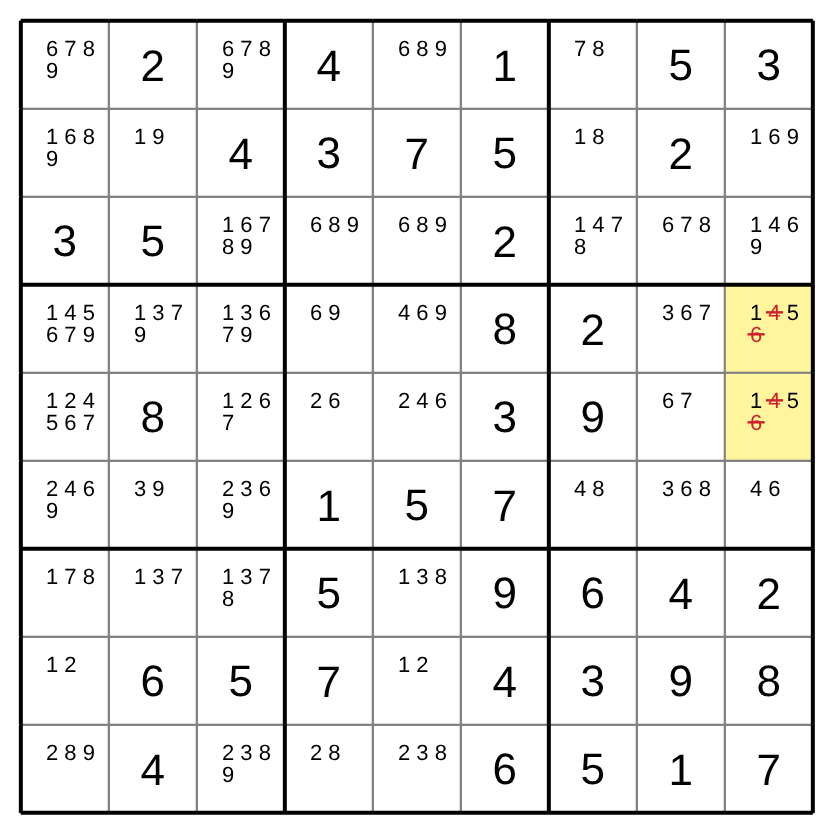
Look at the middle-right box, and at two cells in its rightmost column: the fourth and fifth rows. Each has four candidates: 1, 4, 5 and 6. Nothing about them stands out.
Now ask where 1 and 5 can go in this box. Check the other empty cells: 3, 6 and 7; 6 and 7; 4 and 8; 3, 6 and 8; 4 and 6. None of them has a 1 or a 5. The box needs both digits, and these two cells are the only places for them.
So one of the two cells is 1 and the other is 5, and there is no room left in them for anything else. Their 4 and 6 come out, leaving both cells with just 1 and 5. The hidden pair has become a naked one.
How to look for them
- Ask the question by digit. For each house, take each digit that isn't placed yet and count the cells it can go in. When two digits both have exactly two cells, and they are the same two, it's a hidden pair.
- Start with the digits that have the fewest places. A digit already placed six or seven times on the board has few spots left anywhere.
- Use full notes. Hidden pairs are very hard to find without every candidate written in. The Fill Notes button in the More menu does it in one tap.
Why it works
The house has to contain both digits, and only two cells can take them. If either cell held anything else, one of the two digits would have nowhere to go. So both cells are spoken for.
The same holds for three digits that fit only in the same three cells, which is a hidden triple.
Where it fits
A hidden pair is the first technique of the Hard grade here, along with the hidden triple and pointing pairs. If you've found every hidden single and naked pair and the puzzle has stopped, this is a good thing to try next.
More techniques
- Naked Single (Obvious Single): A cell with only one candidate left must hold it. The first thing to look for in any sudoku, and how to spot it quickly.
- Hidden Single: When a digit fits in only one cell of a row, column or box, it goes there, even if that cell has other candidates.
- Naked Pair (Obvious Pair): Two cells in a house with the same two candidates take both digits between them, so the rest of the house can't have either.
- Naked Triple (Obvious Triple): Three cells in a house whose candidates use only three digits take all three, even when no cell shows all of them.
- Hidden Triple: Three digits confined to the same three cells of a house claim them, clearing out every other candidate in those cells.
- Pointing Pairs and Triples: A digit confined to one line inside a box (or to one box along a line) can be removed from the rest of that line or box.