The 45 Rule in Killer Sudoku
A technique for Killer Sudoku.
The 45 rule is the most useful idea in killer sudoku. It rests on one fact: every row, column and 3×3 box holds the digits 1 to 9 once each, and 1 + 2 + … + 9 = 45. So you always know a house's total, even when the cages don't tell you.
Innies
Pick a house and find the cages that sit entirely inside it. Add up their totals and subtract from 45. What is left is the total of the cells in the house that those cages don't cover. These leftover cells are called innies.
- One innie is a placement: its digit is the remainder.
- Two or three innies form a cage of their own, one that isn't drawn on the board. They share a house, so their digits are different, and you can work them with cage combinations exactly like a drawn cage.
A placed digit among the innies counts too: subtract it from the remainder, and work out the rest of the cells.
An example
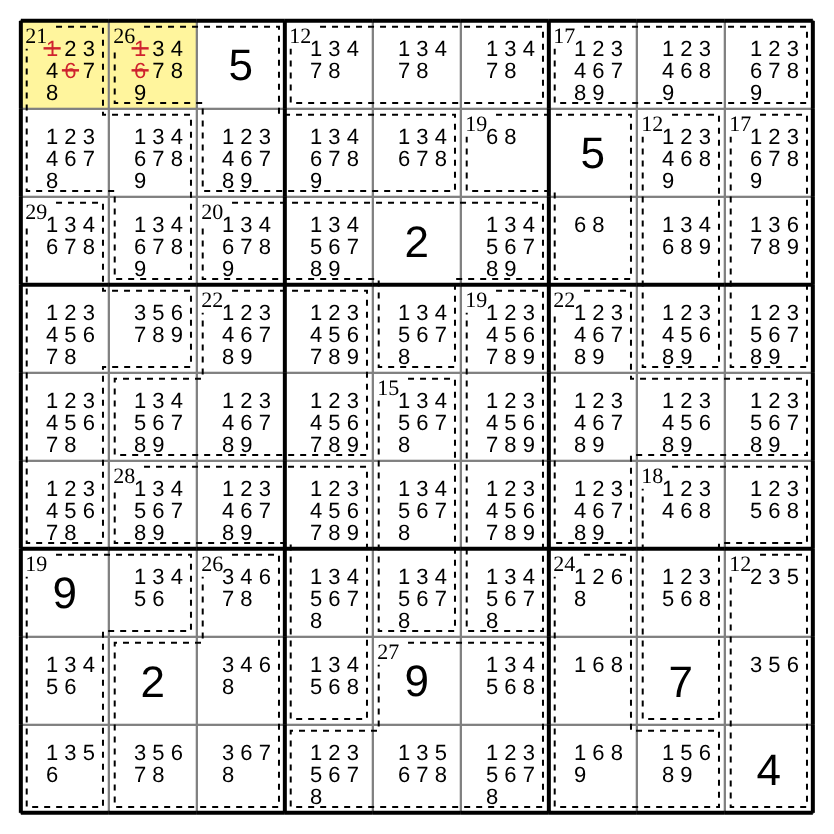
Look at the top row. Two cages lie wholly inside it: the 12 over the fourth to sixth cells, and the 17 over the last three. The first three cells belong to cages that spill down into the rows below, so they are the innies.
- The row totals 45. Take away the two whole cages: 45 - 12 - 17 = 16. The three innies add up to 16.
- The third cell is already 5, so the first two cells add up to 11.
- They are in the same row, so they are different digits. The pairs that make 11 are 2+9, 3+8, 4+7 and 5+6.
- 5+6 needs a 5, and the row already has one. So neither cell can be 6.
- Neither cell can be 1 either: the other would have to be 10.
That strikes 1 and 6 from both cells. It doesn't place a digit yet, but it is the move this board needed: before it, no other technique could make progress. Every killer graded hard here has at least one point like this.
Finding a house to use
The rule works on any house, but some are more useful than others. Look for:
- Houses almost covered by whole cages. One to three cells left over is ideal. Four or more leftover cells give a total with too many combinations to say much.
- Small cages along the edges. Rows and columns at the edge of the grid often contain short cages lying flat along them.
- Boxes. Cages tend to stay compact, so a box is often the house with the most whole cages in it.
Beyond a single house
The same arithmetic stretches further. The app's hints only use innies in a single house, since that is all its puzzles need, but these are worth knowing for harder killers elsewhere:
- Several houses at once. Two adjacent rows total 90, three total 135. A group of cages that fills two rows except for a few cells gives those cells' total.
- Outies. When the cages touching a house cover it completely but stick out of it by a cell or two, the total of those cages minus 45 is the total of the cells sticking out.
- Innies and outies together. When both are present, the difference between the innies and the outies is known, which can be just as useful as a total.
Where it fits
The 45 rule is what makes a killer hard here. A medium killer can be solved with cage combinations and the classic singles and pairs; a hard one needs a 45-rule total, or one of the harder classic patterns such as a hidden pair or pointing. When the Next step hint says "45 rule (innies)", look for a house with a few cells left uncovered.
For the rules and the rest of the strategy, see the killer sudoku guide.
More techniques
- Killer Sudoku Cage Combinations: Which sets of distinct digits add up to a cage's total, and how the short list for a small or extreme cage narrows its cells.