Killer Sudoku Cage Combinations
A technique for Killer Sudoku.
Every cage in a killer sudoku is a small sum: a set of different digits that adds up to the number in its corner. Cage combinations is the technique of listing the sets that can make that total, then keeping in each cell only the digits that appear in a set that still fits. It is the first thing to do with a killer, and the technique you will use more than any other.
How many ways can a cage be made?
Fewer than you might think, because a cage can't repeat a digit. Two cells can add up to anything from 3 (1+2) to 17 (8+9), three cells from 6 to 24, four from 10 to 30. Near either end of the range there is only one way to make the total:
| Cells | Low totals | High totals |
|---|---|---|
| 2 | 3 = 1+2 4 = 1+3 |
16 = 7+9 17 = 8+9 |
| 3 | 6 = 1+2+3 7 = 1+2+4 |
23 = 6+8+9 24 = 7+8+9 |
| 4 | 10 = 1+2+3+4 11 = 1+2+3+5 |
29 = 5+7+8+9 30 = 6+7+8+9 |
| 5 | 15 = 1+2+3+4+5 16 = 1+2+3+4+6 |
34 = 4+6+7+8+9 35 = 5+6+7+8+9 |
Totals in the middle have more, but even they rule things out. Some things worth knowing:
- A two-cell cage with an even total can't hold half of it. 10 is never 5+5 and 12 is never 6+6, so a two-cell 10 has no 5 and a two-cell 12 has no 6.
- A two-cell cage with a high total has no small digits. The larger cell can be at most 9, so in a two-cell 13 the other is at least 4.
- A big cage is about what's missing. A cage of eight cells holds every digit but one, and the missing digit is 45 minus the total. A cage of seven is missing two digits that add up to 45 minus the total.
- A cage of one cell is its total. The app's hints call this "Single-cell cage", and it is as easy as a given.
An example
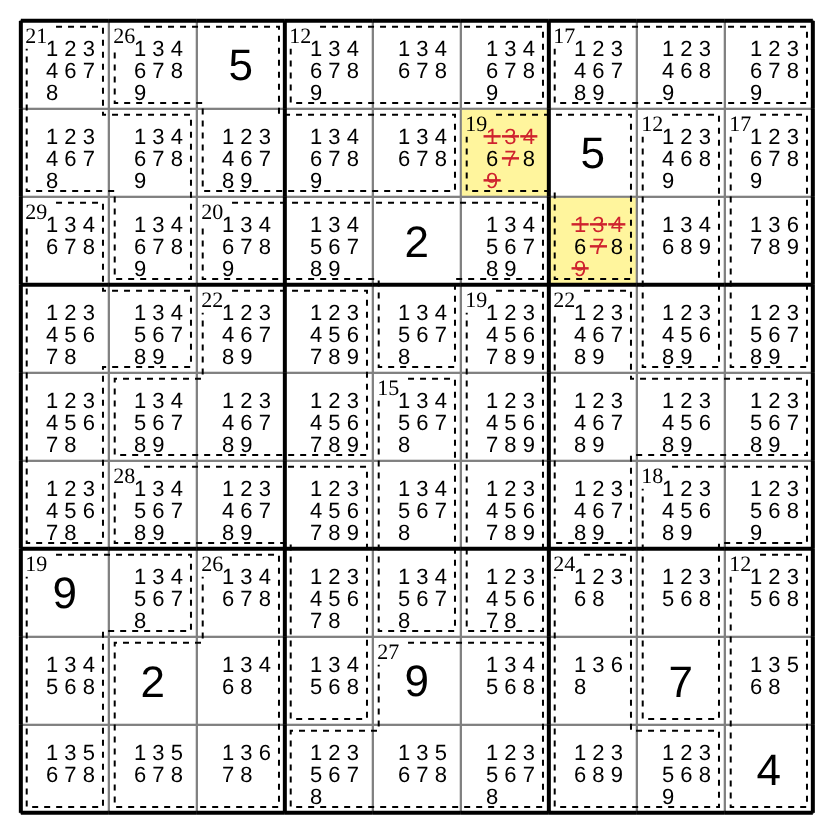
Near the top of the board, a cage totalling 19 covers three cells: the sixth cell of the second row, the seventh cell of the same row, and the seventh cell of the third row. The middle one already holds a 5.
- Take away what's placed. 19 - 5 leaves 14 for the two empty cells.
- List the pairs of different digits that make 14: 5+9 and 6+8. (7+7 is out, since a cage can't repeat.)
- 5+9 needs a second 5, and the cage already has one. That leaves 6+8.
So both empty cells are 6 or 8, and every other candidate goes: 1, 3, 4, 7 and 9 are struck from each. Notice that those two cells are in different rows, columns and boxes, so nothing in the classic rules links them. Only the cage does.
The pair doesn't say which cell is 6 and which is 8. That usually comes a few moves later, when one of the two digits is ruled out of one cell by its row, column or box.
Working a cage with more combinations
When a cage has several combinations, write them down and test each one against the cells:
- Strike a combination if one of its digits fits in none of the cage's cells. A three-cell 15 could be 1+5+9, but if the row, column and box rule 9 out of all three cells, 1+5+9 is gone.
- Strike a candidate that appears in no combination left. Once 1+5+9 goes, a 1 that only appeared in it goes too.
- Look for a digit common to every combination. If every way of making the total includes a 7, the cage contains a 7, and when the cage lies inside one box (or row, or column) no other cell there can be 7.
Each placement on the board feeds back into this. It is worth returning to a cage you've already worked whenever a digit lands in one of its houses.
Where it fits
Cage combinations is the technique that makes a killer medium rather than easy: with so few digits given, every killer needs it before the naked singles and hidden singles start to flow. When combinations alone stop giving you anything, the next step is usually the 45 rule, which builds new sums out of whole rows, columns and boxes and feeds them back to this same technique.
For the rules and the rest of the strategy, see the killer sudoku guide.
More techniques
- The 45 Rule in Killer Sudoku: Every row, column and box adds up to 45. Subtract the cages that sit wholly inside it and what's left is the total of the cells that remain.