Checking Every Ordering
A technique for Skyscraper Sudoku 5×5.
The shortcuts in skyscraper sudoku, the edge clues and the tallest-tower bound, each read one particular thing from a clue. When they stop helping, there's a method that reads everything: list the orderings of the line that its candidates still allow, keep the ones whose visible count matches the clue, and strike any candidate that none of them uses.
It's the most general technique in skyscraper, and the one that makes every puzzle here Expert. It is also less work than it sounds, because a line has only five cells.
An example
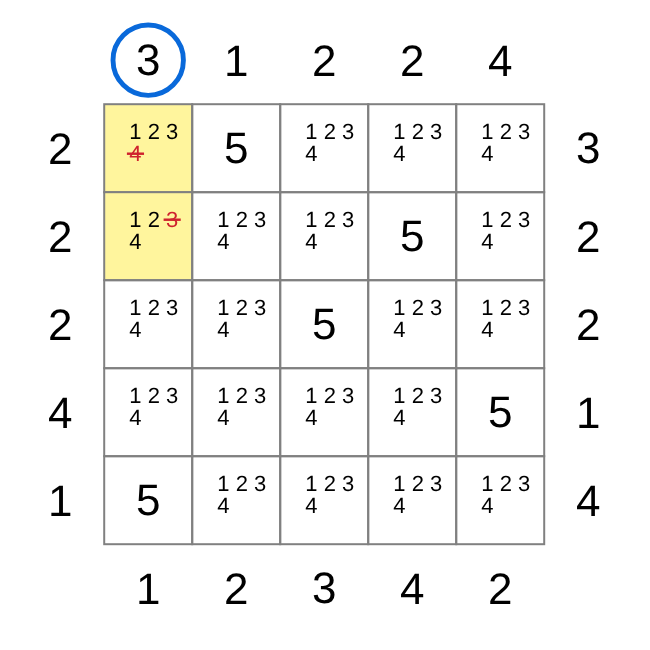
Above the first column is a 3. The bottom cell of the column is already 5, so the top four cells hold 1, 2, 3 and 4 in some order.
Seen from the top, the 5 at the bottom is always visible. So exactly two of the top four towers must be visible in front of it. Now ask what each cell can be.
- Can the top cell be 4? Then it hides 1, 2 and 3 behind it, and only the 4 and the 5 are visible. That's 2, not 3. So the top cell isn't 4.
- Can the second cell be 3? The top cell would then be 1 or 2 (not 4, as we just saw, and not 3). From the top you'd see that tower, then the 3, then the 4 somewhere below, then the 5. That's 4, one too many. So the second cell isn't 3.
Those are the only two candidates that no valid ordering uses. Of the 24 ways to arrange 1 to 4 in those cells, eleven give a count of 3. Between them they use every other candidate in every cell, so nothing else goes.
The app's Next step hint calls this "Skyscraper elimination".
Doing it by hand
You don't need to write out all the orderings. A few habits keep it short:
- Fix the tall towers first. Where are the 5 and the 4? Most of what a clue sees depends on those two.
- Ask about one candidate at a time. "Can this cell be 4?" is a small question: place it and see whether the clue can still be met. If it can't, strike it.
- Pick the most constrained line. A line with two or three cells known has only a few orderings left, sometimes just one or two.
- Use both ends. A line has a clue on each side. An ordering has to match both.
Why it always works
Every other skyscraper technique is a special case of this one. A clue of 1, a clue of 5, the tallest-tower bound: each is what you'd find by trying the orderings and noticing a pattern. So when nothing else moves, this is guaranteed to find whatever the clue can tell you. It's slower than the shortcuts, which is why you save it for last.
For the full rules and the rest of the strategy, see the skyscraper sudoku guide.
More techniques
- Skyscraper Edge Clues: 1 and N: A clue of 1 puts the tallest tower right beside it. A clue equal to the line's length means the towers climb one step at a time.
- Placing the Tallest Tower: A clue of k needs k−1 shorter towers in front of the tallest one, so the tallest can't stand in the k−1 cells nearest the clue.