Skyscraper Edge Clues: 1 and N
A technique for Skyscraper Sudoku 5×5.
Two clues in skyscraper sudoku tell you a line outright. A 1 fixes the cell nearest it, and a clue equal to the line's length, 5 on this board, fixes the whole line. They're the first things to look for on a new puzzle, and on an empty grid they're often the only place to start.
A clue of 1
From the clue, the nearest tower is always visible. A clue of 1 says it's the only one, so it must hide everything behind it. Only the tallest tower can do that, so the cell next to the clue is the 5.
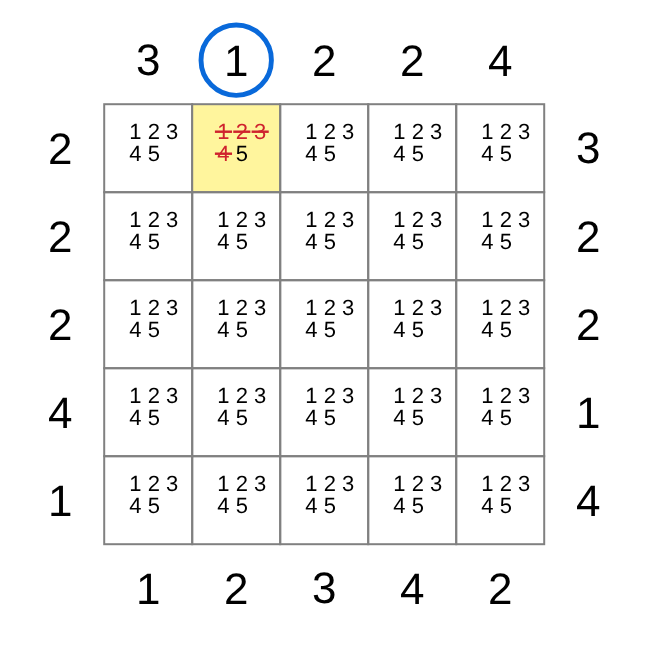
Above the second column there is a 1. The top cell of that column must be 5: if it were anything shorter, the 5 further down the column would be visible too, and the count would be at least 2. So 1, 2, 3 and 4 are struck out of it.
The same board has three more 1s around its edge. Each places a 5, and since every row and column has exactly one 5, they quickly start to rule each other out. On many boards the 5s are almost entirely decided by the 1s.
A clue of 5
A clue of 5 says every tower in the line is visible. For that to happen, each tower must be taller than all the towers in front of it. On a line of five cells holding 1 to 5, there is only one way: 1, 2, 3, 4, 5, rising away from the clue.
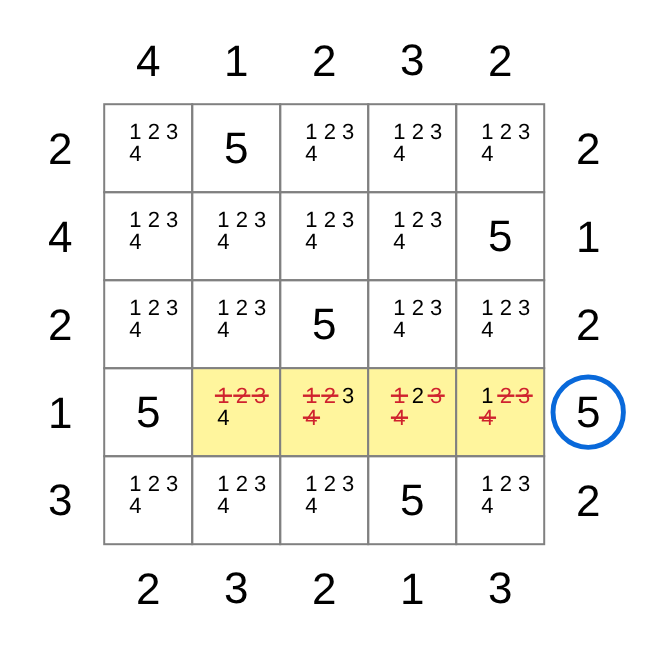
To the right of the fourth row is a 5. Reading from the right, the row must be 1, 2, 3, 4, 5. So the cell nearest the clue is 1, the next is 2, then 3, then 4, and the far cell is 5. In the example, the far cell already held the 5, placed earlier from the 1 on the row's left side. The two clues agree, which is a good sign that you've read them correctly.
The app's Next step hint calls this "Skyscraper full run".
Why only 1 and 5?
The clues in between, 2, 3 and 4, allow more than one arrangement, so none of them fixes a cell on its own. They still say a lot, though:
- A clue of 2 means the 5 isn't next to the clue, and the nearest tower is the only one visible in front of the 5.
- A clue of 4 means the 5 is at least four cells from the clue, so it's in one of the two far cells.
That second kind of reasoning is the next technique: placing the tallest tower. And when no shortcut applies, there is always the method that covers every clue: checking every ordering.
For the full rules, see the skyscraper sudoku guide.
More techniques
- Placing the Tallest Tower: A clue of k needs k−1 shorter towers in front of the tallest one, so the tallest can't stand in the k−1 cells nearest the clue.
- Checking Every Ordering: When the shortcuts run out, try each ordering of a line that the candidates allow, and keep only the digits that some valid ordering uses.